

Ultrasonic Oil-Water Emulsification: Principles, Value, And Application Overview
Dec 25, 2025
In industrial production and daily life, the mixing of oil and water is ubiquitous. However, the natural immiscibility of oil and water often hinders technological implementation. The emergence of ultrasonic emulsification technology has successfully broken down this barrier, achieving stable fusion of oil and water through physical processes, bringing technological innovation to multiple industries. This article will analyze the core principles of ultrasonic oil-water emulsification in detail, explain the core reasons for adopting this technology, outline the industries it supports, and summarize its unique advantages.
I. In-depth Analysis: Why Can Ultrasonic Waves Emulsify Oil and Water?
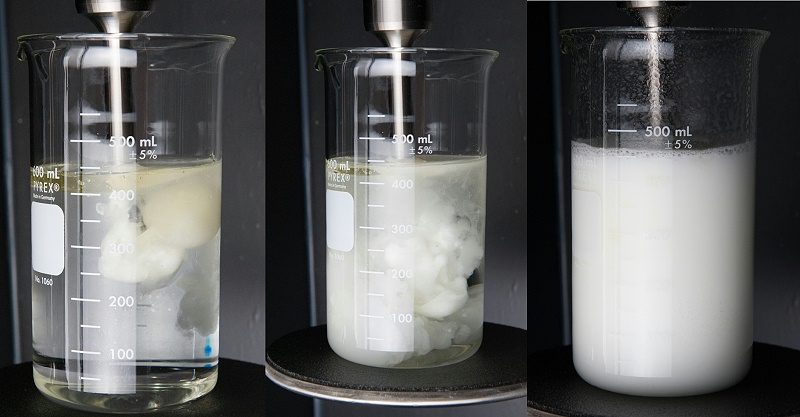
To understand the emulsifying effect of ultrasound, we must first clarify the essence of "emulsification"-that is, to form a uniform and stable dispersion system between two immiscible liquids (in this case, oil and water), where one liquid is uniformly dispersed in the other as tiny droplets. The core reason why ultrasound can achieve this process lies in the cavitation effect it induces, supplemented by the synergistic effect of mechanical vibration and thermal effects. The specific process can be divided into three key stages:
The first stage is the formation and growth of cavitation bubbles. When ultrasound is applied to an oil-water mixture, the liquid molecules vibrate violently under the periodic pressure changes of the sound waves. In the "negative pressure phase" (decrease), tiny gas nuclei in the liquid (such as dissolved gases or gases in the pores of tiny impurities) rapidly expand, forming numerous tiny cavitation bubbles. In the "positive pressure phase" (decrease), these bubbles are rapidly compressed, their volume continuously shrinking.
The second stage involves bubble bursting and the release of intense physical forces. When the bubbles are compressed to their limit, they burst instantaneously, a process that takes only microseconds but releases extremely high energy-including localized high temperatures (up to thousands of degrees Celsius), high pressures (up to hundreds of megapascals), and high-speed microjets (flow velocities up to tens of meters per second). This extreme local environment is the key driving force for oil-water emulsification: the high-speed microjets act like countless tiny "scissors," forcibly tearing and breaking down large droplets in the oil or water phase into extremely small (typically micrometer- or even nanometer-sized) dispersed droplets.
The third stage is the formation of a stable dispersion system. The high-frequency mechanical vibration of ultrasound continuously agitates the oil-water mixture, allowing the broken droplets to disperse evenly within the continuous phase, preventing rapid aggregation and stratification. Simultaneously, the localized high temperatures generated by cavitation slightly reduce the liquid's viscosity, further promoting droplet dispersion and mixing. If an emulsifier is added to the system, the ultrasound can accelerate its adsorption on the droplet surface, forming a stable interfacial film, further enhancing the stability of the emulsion system and allowing the oil-water mixture to remain homogeneous for an extended period.
II. Core Choice: Why Use Ultrasonic Equipment for Oil-Water Emulsification?
Before the advent of ultrasonic emulsification technology, traditional emulsification methods such as mechanical stirring and high-pressure homogenization were commonly used in industry. However, with increasing demands for emulsification quality, efficiency, and environmental friendliness, ultrasonic equipment has gradually become a better choice. The core reasons are as follows:
Firstly, traditional emulsification methods have significant limitations. Mechanical stirring relies on the rotation of blades to generate shear force, but the uneven distribution of shear force makes it difficult to break droplets into tiny sizes, resulting in poor emulsification and a tendency for localized over-stirring leading to material deterioration. High-pressure homogenization, while producing finer droplets, requires equipment to withstand extremely high pressure, resulting in high energy consumption, noise, and wear and tear, leading to high maintenance costs. It is also less effective at handling high-viscosity materials.
Secondly, ultrasonic emulsification precisely overcomes the shortcomings of traditional technologies. The cavitation effect of ultrasound generates extremely strong and uniformly distributed shear force, easily breaking droplets into micron- or even nanometer-sized particles, resulting in higher emulsification precision and a more uniform and stable emulsion system. Simultaneously, ultrasonic equipment consumes only 1/3 to 1/2 the energy of high-pressure homogenizers, operates with lower noise, and has a relatively simple structure, resulting in less wear and lower maintenance costs. Furthermore, ultrasonic emulsification is a gentle process that can be performed at room temperature, avoiding the damage of heat-sensitive materials (such as active ingredients in food and cosmetics) caused by high temperatures, thus broadening its applicability.
Finally, ultrasonic emulsification offers greater operational flexibility. By adjusting parameters such as ultrasonic power, frequency, and processing time, the size of emulsion droplets and the stability of the emulsion system can be precisely controlled, adapting to the emulsification needs of different materials. Simultaneously, ultrasonic equipment can achieve continuous production as well as batch production, adapting to different scale production scenarios and exhibiting strong adaptability to materials, achieving efficient emulsification of both low-viscosity light oils and high-viscosity heavy oils.
III. Industry Empowerment: Which Industries Does Ultrasonic Oil-Water Emulsification Support?
Ultrasonic oil-water emulsification technology, with its unique advantages, has widely penetrated multiple industries, becoming a key technology driving industry technological upgrades and improving product quality. The main industries it supports include: food processing, cosmetics, pharmaceuticals, petrochemicals, coatings and inks, and new energy. In these industries, oil-water emulsification is one of the core production steps, and the application of ultrasonic technology significantly improves production efficiency and product competitiveness.
IV. Application Scenarios: Specific Application Areas of Ultrasonic Oil-Water Emulsification
Combining the industries mentioned above, ultrasonic oil-water emulsification has a wide variety of specific applications, covering multiple areas of production and daily life:
In the food industry, it is mainly used for dairy products (such as homogenization and emulsification of milk and yogurt to improve texture), beverages (such as emulsification of oil-containing functional beverages and fruit juices to prevent separation), condiments (such as emulsification of salad dressings and mayonnaise to ensure uniform texture), and edible oil processing (such as emulsification and stabilization of blended oils to improve quality). It can also be used for the emulsification and dispersion of food additives, such as uniformly dispersing fat-soluble vitamins and flavorings in aqueous solutions to improve additive utilization.
In the cosmetics industry, it is one of the core technologies for the production of skincare and makeup products. For example, ultrasonic emulsification is used in the emulsification of face creams and lotions (evenly mixing oils and water to form a smooth, easily absorbed texture), sunscreens (evenly dispersing sunscreen ingredients to enhance sun protection), and makeup products such as lipsticks and eyeshadows (ensuring a smooth and stable product texture). Furthermore, in the production of shampoos and conditioners, ultrasonic emulsification allows for the even dispersion of oil-based conditioning ingredients, improving washing and conditioning effects.
In the pharmaceutical industry, it is mainly used in the production of drug formulations. For example, it is used in the emulsification of fat-soluble drugs (converting fat-soluble drugs into emulsions to improve drug solubility and bioavailability), the preparation of intravenous injection emulsions (requiring uniform and small droplet sizes to ensure medication safety), and ointments (evenly dispersing drug components in a matrix to enhance efficacy). Additionally, in the extraction of traditional Chinese medicine, ultrasonic emulsification can assist in the extraction of fat-soluble active ingredients, improving extraction efficiency.
In the petrochemical industry, it is used in crude oil extraction and processing (e.g., emulsifying crude oil with water to form an emulsion, reducing crude oil viscosity, and improving extraction and transportation efficiency), oily wastewater treatment (separating oil from wastewater through emulsification and demulsification processes to purify wastewater), and lubricant production (emulsifying and mixing oils of different viscosities to formulate high-performance lubricants).
In the coatings and inks industry, it is used in the production of water-based coatings and inks. Through ultrasonic emulsification, oil-based resins and pigments are uniformly dispersed in water to form a stable water-based system, replacing traditional solvent-based coatings and inks, reducing VOC (volatile organic compound) emissions, and meeting environmental protection requirements. Simultaneously, emulsified coatings and inks have a more uniform texture, better coating effect, and improved product appearance and performance.
In the new energy industry, it is mainly used in the production of biodiesel. In the preparation of biodiesel, vegetable oils or animal fats need to be emulsified and mixed with alcohols such as methanol for transesterification. Ultrasonic emulsification can accelerate the mixing homogeneity of the reaction system, improve reaction efficiency, reduce reaction temperature and time, and improve the yield and quality of biodiesel.
V. Core Advantages: The Unique Value of Ultrasonic Oil-Water Emulsification
Compared to traditional emulsification technologies, ultrasonic oil-water emulsification has irreplaceable advantages, which can be summarized as follows:
First, high emulsification precision and strong stability. The cavitation effect of ultrasound can break droplets down to the micron or even nanometer scale, resulting in an emulsion system with extremely high uniformity. Furthermore, the small droplets have a large specific surface area. If an emulsifier is added, a stable interfacial film can be quickly formed, effectively preventing droplet aggregation and stratification, and extending the shelf life of the emulsion system.
Second, low energy consumption and low cost. Ultrasonic equipment consumes only about half the energy of high-pressure homogenizers, does not withstand high pressure during operation, experiences less wear and tear, and has significantly lower maintenance costs than traditional equipment. Furthermore, ultrasonic emulsification reduces the amount of emulsifier used (typically by 30%-50%), further lowering raw material costs.
Third, it is gentle to operate and widely adaptable. Ultrasonic emulsification can be performed at room temperature, avoiding the damage of heat-sensitive materials caused by high temperatures, making it suitable for temperature-sensitive industries such as food, cosmetics, and pharmaceuticals. It also has strong adaptability to the viscosity and concentration of materials, achieving efficient emulsification for both low-viscosity liquids and high-viscosity pastes, and can be adapted to the needs of different materials by adjusting parameters.
In summary, ultrasonic oil-water emulsification technology, with its unique operating principle and significant advantages, has become a core technological support for many industries. It not only solves the technical challenge of the natural immiscibility of oil and water but also drives related industries towards high efficiency, environmental protection, and high quality. With continuous technological upgrades, the performance of ultrasonic emulsification equipment will be further improved, and its application areas will continue to expand, bringing innovative vitality to more industries.